TURIYA LITERARY REVIEW
TLR Issue 2-Summer 2026
Ashes
Fiction by Pavannan
Translated from the Tamil by Megana Kumar
First published in the anothology, "Born With the Southern Wind," Thiru Publications, London, UK.
“What is this? Some new ritual?” Sundari scoffed. “We didn’t do this for any of our grandparents or great-uncles. Usually, the day after the cremation, people return to the crematorium and pour milk on the ashes. From there, they scoop a handful and put it in a small bronze container, and put a cloth over it. Then they go straight to Srirangapatnam and spread the ashes in the river. That’s what I’ve seen.”
Velu didn’t respond right away. He shook his head, letting out a heavy sigh. He couldn’t bring himself to look at her. “When a man tells you he wants his ashes scattered in the Ganges after he dies, you can’t say no,” he said in a soft voice.
Sundari cut in. “Sure, they all say that like it’s nothing, but who’s supposed to pay for it?” she asked. Velu didn’t have an answer. He just watched as his oldest daughter, still in her school uniform, helped the other two kids get dressed. Sundari pressed on. “You think going to Kashi is like going from Ulsoor to Majestic? Two days there. Two days back. And we need money for everything in between, you know?”
He stayed quiet. Without a word, he turned toward the wall and looked at the bronze urn sitting by it, holding the ashes. Above it hung a garlanded photo of his father. A lamp flickered nearby.
His father had been a strong, sincere man. Years of hauling rice bags at the market had hardened him. When Jayaraman Udayar, the owner of the rice store in the market, opened a mill in Ulsoor, he offered his father a job on a monthly salary. His father vacated his rental in Chamarajpet and moved to a new place in Ulsoor. His honesty and hard work earned him respect. He learned many things from his boss and his family. One of those things was the custom of the Kashi pilgrimage.
Sundari stared at the urn. It was just ashes to her, nothing more. The urge to stop this trip to Kashi by any means necessary clawed at her insides. “So the ashes will only dissolve if we go all the way to Kashi and throw them in the Ganges? That’s the only place they’ll dissolve?” she bit out.
“Of course they’d dissolve anywhere…I mean, ashes dissolve wherever you scatter them. But there’s a belief; if done in the Ganges, one won’t get stuck in the cycle of rebirth. Our generations will be blessed. Something like that. People have been doing this for ages with that belief, haven’t they?” he coaxed.
“Sure,” Sundari huffed, turning away. Velu’s words weren’t making sense to her, so her irritation only grew.
An easy conversation with Sundari was impossible. Bitterness, irritation, and resentment were inevitable. Her words scalded, like hot water splashed on bare skin. “You don’t even know how to pick out decent spinach. Can you even tell the difference between good and rotten fruit? I told you to come at six, and you show up at seven. What’s that about? Everything I say is worthless, isn’t it?” Every conversation started with a complaint.
“Forget about right or wrong. He was an old man! We’ve already spent so much. What are we going to lose by spending a little more to fulfill his last wish?”
“Oh, we wouldn’t lose anything at all. All I’ve seen in this house is wealth. That’s what I’ve been seeing for the past ten, sorry, twelve years! Didn’t you notice?” Sundari retorted.
“As if the expenses ask for permission before they show up! They just do! And when they do, we’ll take out a loan and manage somehow.”
“Forget about that. We can’t even figure out how much the funeral already cost. Don’t you remember the money we got from pawning the earrings my mother gave me?”
“I do! I do! When did I say I didn’t? Why are you throwing that in my face now? All I said was we have to pay this off, along with the rest of our bills. Only then will we have any peace.”
“What do we even have left to give? Only my thāli!”
“Aiyo! Why do you have to say such horrible things first thing in the morning? Can’t you say anything nice? Do you even hear yourself?”
Rage boiling in his body, he raised his hand to strike her. But he stopped mid-motion, instead whacked his own head over and over with his hand. Seeing the children, ready with backpacks and in their uniforms, shrink back in fear, he too retreated to a corner of the house.
“What, you stopped? Go ahead, beat me to death and burn me too!” Sundari mocked. “Rather than dying here slowly every single day, I’d rather just get it over with!”
Velu felt drained of his will to fight. He lifted a hand, brushing the dampness from his eyes.
“Come on, this isn’t ending anytime soon. We’re going to be late for school,” he told his children, ushering them out with him.
Sundari was right on his tail.
“Whether you go to Kashi or Rameshwaram to scatter the ashes, I don’t care. Just finish it quickly. Keeping them here in the house isn’t right. Children live here. Don’t forget.”
Without looking at her, he hung the children’s backpacks on his bicycle’s handlebars. With one child in the front and another in the back, he started pedaling.
His father, when he was alive, had asked him several times, “Why do you fight with her all the time? You can’t have a meal together peacefully? What are you even fighting about? Your mother and I lived together for thirty years. We never fought once.”
“We don’t fight, Appa.”
“Then what do you call the way you two talk to each other?”
“It’s not a big deal. Just normal things. Don’t worry about it.”
He’d never told him the reason for their fights. He’d decided it was better for his father not to know than to find out and be hurt by it.
Velu and Sundari’s fathers were childhood friends who grew up as neighbors in Chamarajpet. They’d started working as loaders in the market stalls. When Velu’s father moved to Ulsoor, the two friends gradually lost touch. Two years had passed since; Velu’s father began searching for a bride for his son, but for various reasons, they’d been unable to find a suitable match. Finally, he reached out to his old friend and arranged the marriage with his daughter, Sundari.
At the wedding, as they exchanged garlands, Sundari didn’t even lift her head to look up at Velu. She simply raised her hands and slipped the garland around his neck, her head bowed. Perhaps it was just the shyness of a new bride, he’d thought. But throughout the ceremonies, he noticed that there wasn’t even a trace of a smile on her face. When they sat beside each other, at the banquet, he truly knew that something was wrong. He caught sight of her fingers wandering aimlessly through the mound of rice on the plantain leaf.
After the meal, Sundari’s father found him washing his hands in the back of the dining hall. “Velu, Thambi, one minute. I need to speak to you alone,” he said, moving closer. Velu wiped his hands with a handkerchief. “Tell me, Mama.”
“Thambi, when your dad asked me to arrange this marriage, I said yes without thinking it through. I had that wish in my heart too. However, my daughter was harder to sway. I guess she had imagined herself marrying someone different; someone working in a school, or an office. I’ve tried to convince her as best I could. She’s a stubborn girl, but she has a heart of gold. You’ll understand, give it time. But between us, you’re the one who has to convince her it’s worth it.”
“Don’t worry, Mama, she’ll get used to me,” Velu assured him. But throughout their married life, he was never able to thaw the cold bitterness in her heart. Constant fights and arguments became impossible to avoid.
When he got home from dropping the children off at school, his mind was consumed by getting the money together for the Kashi ritual. He racked his brain trying to figure out who he could ask for a loan. He’d already borrowed money from so many people.
As he passed his boss’s house, near the Someswarar temple, he decided to talk to his boss about it. It felt more appropriate to meet him at home rather than at the store. He parked his bicycle near the house and rang the bell. The boss’s wife answered the door.
“Come in, Velu. Is everything all right?”
“Almost. Just one little job left to do.”
The boss came outside, buttoning his shirt. “What’s up with this little job, big job?” he asked. Velu greeted him quickly.
“My father’s ashes are still at the house. I need to scatter them.”
“That’s not a big job at all! Everyone does that, right? What’s the problem?”
“My dad had a wish; that his ashes be taken to Kashi and scattered in the Ganges.”
“Kashi? Why there?”
“I don’t know. It was his last wish.”
“The trip would be expensive though, wouldn’t it?”
“I know, that’s why I’m here, Ayya. It’d be a great help if you could lend me five thousand rupees.”
“What is this, Velu? You ask as if it’s nothing – like you need four or five rupees. Where am I supposed to get that kind of money on such short notice? You know how this business works; cash comes and goes. Don’t you know that?”
“Even four thousand would work! I could manage with that.”
“Aiyo, I don’t know how else to explain this. It’s not like I’m holding out on you. If I had it, who else would I give it to but you?”
“I’ve tried everything. I don’t know where else to turn to. Please, at least a couple thousand.”
The boss studied his face for a moment without a word. Then, with a heavy sigh, he said, “Velu, try somewhere else. Talk to your friends if you can. Take care of your personal situation first, then come to the shop when you’re ready.” He shook out the towel in his hands, hung it on a nearby clothesline, and disappeared inside.
Velu’s face fell, and he turned to the boss’s wife.
“Why expect to find it all in one place, Velu? When your boss heard about your father’s death, didn’t he help? Didn’t we give you what we had then? We simply don’t have it now. What can I do? Look somewhere else. You’ll find a way.”
With a lingering glance that said goodbye, she went back inside.
Velu couldn’t face coming home. His mind churned endlessly between two paths: the funeral rites or the pilgrimage to Kashi. Fulfilling the funeral rites would be easy enough: shave his head on the fifth or seventh day, come back, and make a modest offering. It wouldn’t cost much either. But Kashi? That was something else entirely. A pilgrimage like that would bleed him dry. His thoughts circled endlessly as he pedaled the bicycle wheels, mirroring the rhythm with his indecision.
When he stopped at the Murphy Town intersection, a pushcart piled with vegetables pulled up next to him. The sight of it sparked a memory of his friend, Singharam. He could probably find Singharam’s cart there, at Murphy Town Market. He got off his bike and walked it to the market. The road was packed with shops, sacks stacked in front of them, vendor carts everywhere. The chaos of people coming and going.
He spotted his friend Singharam’s vegetable cart parked under a white gulmohar tree, and felt the bloom of relief. Singharam noticed him and came over. “Vaada, back at work already? When are you finishing the karumadhi? Are you calling everyone to do it, or doing it yourself?”
“That’s why I’m running myself ragged, Singharam,” Velu said with a sigh. He parked his bike and walked toward him. He explained in detail why he needed the money. “Singharam, is there any way I could get a couple thousand rupees?”
“Even if I sold everything in this cart, I wouldn’t get two thousand rupees! Why are you springing this on me now?”
“Singharam, come on. I know you’re just like me. I only asked if you could scrape it together somehow.”
“Who’s going to trust me enough to give me a loan? If you have jewelry, you can pawn it. People trust jewelry more than they trust us.”
“We already pawned Sundari’s earrings to pay for my father’s funeral. There’s no jewelry left to pawn. Is there no one who’ll lend us money on trust?”
“Trust? Around here? That’s rich. The minute money is mentioned, the masks come on. Every single one of them shows a different face. Brother or not, everyone’s got their own mouth to feed, their own belly to fill. That’s just how it is.”
“What about a loan with interest?”
“Sure, they’ll give it to you, but can you pay interest every single day?
“Every day?!”
“That’s how it works here. You borrow a hundred rupees, you have to pay ten toward the principal and ten in interest. Every. Day. Can you handle that?”
“Aiyo, there’s no way to get money at all? Last year, when I was short of a thousand rupees for my daughter’s school fees, you helped me out. I thought maybe this time…”
“Come on, Velu. Why can’t you understand? That was my own money. I had it then, so I gave it to you. Now I don’t. What do you want me to do?”
For two days, without a moment’s rest, he went from house to house, looking for his close friends. He couldn’t scrape together a single rupee. “I’m struggling just like you, man. Where would I get that kind of money on such short notice?” one friend asked, exasperated. “I could maybe come up with a hundred, two hundred rupees. But thousands? Where am I supposed to find that?” They all had their excuses.
On the fifth day, he shaved his head and completed the final rites at home. He sealed the ashes in an urn, wrapping it tightly in cloth. There was nowhere in the house to store it without someone’s eyes falling on it, and no place for it outside, either. The houses stood packed together in a row, like stacked matchboxes. With no other option, Velu climbed on a stool and placed the urn on a dusty ledge in the loft, out of reach, hidden from view.
“Instead of scattering the ashes, you’re stashing them up there?” Sundari fumed.
“You keep saying get rid of them, get rid of them, but where am I supposed to go? There’s not a place I haven’t been looking for money. There’s no one left to ask. Nothing’s worked. Tell me, what should I do? Right now, going to Kashi is impossible. In two or three months, once we gather money, we can go to Kashi and return. Until then, the ashes stay in the loft.”
“Do whatever you want. When has anything I’ve said ever mattered to you?” Sundari muttered, and walked away. Velu quietly left for the shop.
He was determined to travel to Kashi and return within a month of his father’s death—but it didn’t happen. The shop’s accountant, taking pity on him, had promised he’d lend Velu money the following month, when he received some ten thousand rupees from a chit fund. Velu, believing him completely, had begun to drift into hopeful dreams; but when the accountant went to withdraw the money, his wife fell so ill that he had to rush her to the hospital. Her kidneys were failing. The money vanished into medical bills. “I’ll find the money somewhere else, sir. Take care of your wife,” Velu told him. As time went on, every attempt to arrange the money failed.
He saw no option but to postpone the trip to Kashi indefinitely. His fear of breaking his promise gnawed at him everyday. Every time he looked at the urn in the loft, he could almost hear his father’s voice.
As the days passed, Sundari’s complaints intensified. No matter what he said, she refused to understand. If he left in the morning, work at the shop kept him busy until night. Whatever he managed to save from his monthly salary was quickly swallowed up by new expenses.
Once, his oldest daughter came down with typhoid. After more than ten days of treatment, all their savings disappeared. Another time, his youngest son was playing at school when he tripped and broke his arm. The medical bills piled up fast.
Sundari was convinced the ashes were to blame for everything going wrong. Whatever conversation she started, she always led back to the ashes. He didn’t pay much attention to her, figuring she was just speaking out of frustration. All her words went in one ear and out the other.
One morning, he dropped the children off at school and came home to get ready for work. “Look, you’ve made your excuses, but six months have gone by,” she began. “When are you going to bring this to an end?”
Velu, lost in thought, turned to her thickly. “An end to what?”
That question was her breaking point.
“How long are you going to keep those ashes in the house like some decoration? Is this a home or a graveyard? Ever since we’ve had them here, everything keeps falling apart. Don’t you see that? How are you going to fix this?”
He struggled to come up with an answer; her voice was too loud, too sharp. His mind raced. He sighed, looking up at the loft where the urn sat.
“I can’t even drink water in peace because of that urn. I’m constantly afraid something terrible is going to happen tomorrow, or the day after. I haven’t slept in weeks!” Sundari cried.
“Sundari, don’t you know that I’m trying my best to get the money? Nothing is working out. What am I supposed to do? Tell me.”
“God, not this again. I’m sick of hearing the same excuse every single day. I don’t know what you’re going to do or how you’re going to do it. We need to deal with this by the coming new moon. If not, I’ll take the ashes myself and dump them in some dark corner.”
Velu was shaken by her ferocity. “Don’t be upset, Sundari. We’ve made it this far. Can’t we just hang on a little longer?” he whispered, trying to calm her down.
“Look, you know my mood changes every day. One of these nights, when the kids are asleep, I’ll pour kerosene on all of us and burn us all. If you want, you can take all our ashes and scatter them in Kashi.”
Her cold, resolute voice unnerved him. He tried to stay calm, jaw tightening. “Sundari, in two months I’ll get my Diwali bonus from the store. Then I’ll go to Kashi and finish this. Can’t you wait that long?” he pleaded.
“Sure, sure. You think I don’t know you? You say one thing today, and tomorrow, something else. I’m done with your promises. Just go, go!”
“Don’t worry, Sundari. I promise the first thing I’ll do after Diwali is scatter the ashes.”
“No. It happens by the new moon, or I’ll do what I have to do. Nobody is stopping me.”
Her flat voice and the steely look on her face shook him. He left, knowing if he said anything more, the fuse would ignite.
He thought Sundari would have more to say the next day, but he was met with silence. It was her stillness that got under his skin. As the new moon approached, his nervousness turned into genuine fear.
She was the type of person who’d do anything when angry. After all their years together, he knew that for certain. Even though her words were just threats, he couldn’t get them out of his head. Nightmares of ash and kerosene haunted him. He’d jolt awake in the middle of the night, the images seared into his vision. The moment he woke, he’d scramble to check on his wife and children. Only when he saw them sleeping peacefully could he breathe again.
The day before the new moon, he came home after dropping the children off at school. He climbed on a stool, reached for the urn in the loft, and put it in a bag.
Sundari, who’d been quietly watching him, asked. “What are you doing with that?”
He answered, refusing to meet her eyes. “This can’t stay here. And it’s not going to be the reason anyone gets hurt. I can’t watch over everyone every second. My life has no peace anymore. Just let me handle this my way. I’ll scatter the ashes and come back.”
“Tell me where you’re going before you leave.”
“I’m going to Kashi. Happy?”
“Kashi? Really? With what money?”
“If I had money, I’d already be gone, wouldn’t I? I’ll figure it out. Why do you care?”
“How are you getting there? That’s all I’m asking.”
“Not everyone who rides the train buys a ticket. I’ll take my chances. If I’m lucky, I’ll make it to Kashi. If not, I’ll end up in jail.”
Velu bolted out of the house, knowing if he stayed any longer, the argument would spin out of control. “Wait, hold on a minute…” Sundari called after him. He didn’t look back once. He grabbed his shoes by the door and continued walking.
Even after taking the bus to the train station, a powerful mix of emotions whirled inside him. Some sharp combination of fear and determination kept pushing him forward.
The station was bustling. A large screen on the wall displayed scrolling text, showing arrival and departure times. He couldn’t decipher it well enough to tell which train went to Kashi. He approached an elderly man nearby and asked him. The man stopped scrolling on his phone and looked up. “Kashi? The Varanasi Express, right? I think it’s already gone. Hold on a second,” he said, scrolling again. “Yeah, it left at 9 o’clock. But wait, there’s another option. At 1:30 this afternoon, there’s the Karnataka Express. You can take that to Delhi and then get to Kashi from there.”
“Thank you so much, sir,” Velu exclaimed and sat down next to him. His thoughts frayed out in every direction. He had no idea how Sundari felt right now. He could only pray silently. There’s still plenty of time until 1:30, he told himself, trying to stay calm.
After ten minutes with the thought looping around in his head, he stood up. He plodded toward the station entrance, paced around, then came back and went to the ticket counter. “What time is the train to Delhi?” he asked.
“1:30. Karnataka Express.” The clerk didn’t look up.
“How much is a ticket?”
He glanced up. “860 rupees.”
Velu’s throat went dry.
“Okay, thanks,” he said weakly and lumbered back to his seat.
He pulled the money from his pockets and counted it. 116 rupees in coins and bills. He let out a breath and put it all back. Riding without a ticket was the only choice he had.
He watched warily as people came and went for a long time. He wandered to a nearby park and back again. The bright sun made him squint. He should’ve told his boss he was leaving. At the very least, he could’ve told the accountant. His impulsiveness gnawed at him. His boss would probably send someone to the house to check. He couldn’t imagine what Sundari would say.
The clock tower in the distance said it was 1 o’clock. Velu trudged back into the station. At the entrance, he saw “Karnataka Express” written on the side of a train at the first platform. Still uncertain, he asked a man standing nearby, “This is the Delhi train, right?”
“Yeah, yeah, it leaves at 1:30, get on quick!” the man urged.
Velu looked at the train cars and managed a sharp smile. Every compartment was full to the brim. If the reserved cars were this crowded, he couldn’t imagine what the unreserved ones looked like.
A wave of exhaustion and guilt washed over him. Something inside stopped him from boarding. All the spite and anger he’d felt drained away, like water dousing a fire.
It was 1:30. People on the platform and inside the train waved goodbye. Soon the train began to inch forward. His mind screamed at him to get on, get on the train, but his legs were iron, refusing to budge.
Bitterness and exhaustion overwhelmed him as he trudged out of the station. The bag in his hands felt impossibly heavy. He had no idea how he’d face Sundari when he got home. As he wandered aimlessly, sadness settled deep into his shoulders.
Sweat rolled down his back as he walked. The cool, damp air that blew over him finally snapped him back to reality. He’d somehow made it to Ulsoor Lake. He didn’t know how long he’d been walking.
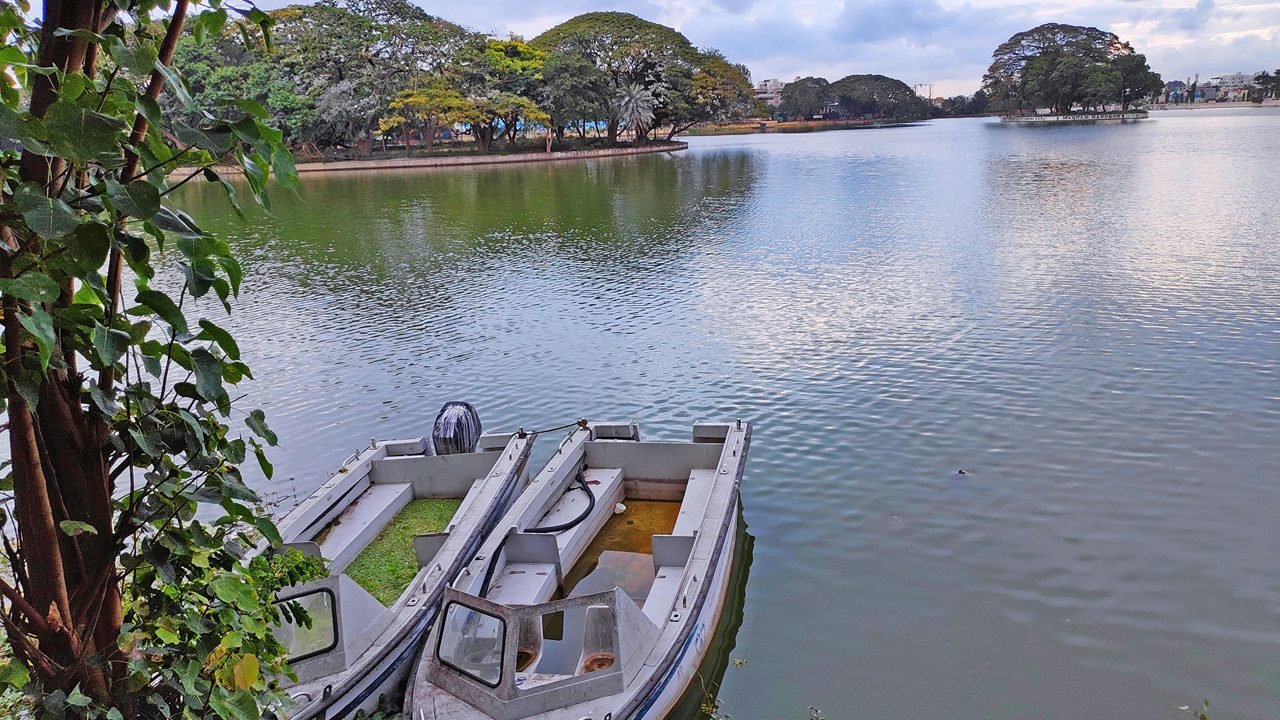
A circular lake stretched before him. Trees lined the banks. A tall green tree rose from an island in the middle, reaching up like a tower. He desperately needed the cool air and peace the place offered. He found a gap in the barbed wire fence and slipped through. Sitting on a bench by the lapping water with not a soul around felt like a relief. All the exhaustion he’d been holding back finally crashed over him.
At the store, customers came in all day and he constantly ran between the entrance and the storage room. But he never felt tired there. After walking from the Majestic station in the blazing sun, though, weariness struck him immediately. He leaned back on the cement bench, closing his eyes.
The sun was setting when he woke. He had no idea how long he’d slept. A flock of crows flew from one side of the lake to the other. The sky’s colors were beginning to dim. Boys and girls laughed as they swung on the swings nearby. A group of tourists climbed off a boat that had been circling the lake. Another group waited to board.
“Last trip! Last trip! If you have a ticket, get on now! No more trips after this!” the boatman shouted. After a few moments, the engine sputtered to life, tuk tuk tuk, and smoke curled up from the back as the boat started to glide across the lake.
“Son, are you from out of town? You’re so exhausted you’re sleeping sitting up. What happened?” Velu peered upwards, only to see an old man. The man’s words passed right over him. Sundari’s voice still echoed in his mind.
“Huh?” he asked. The old man repeated his questions. His dark blue pants and light blue shirt made it clear he was the park watchman. Velu stretched his arms overhead and smiled. “I fell asleep after all that walking.”
“I saw you come in. You had a seat, then stood up and stared at the lake for a while, then sat back down. When I finished my rounds, I saw you fast asleep on the bench. I would’ve woken you if you were lying down, but since you were sitting, I left you alone.”
“I walked a long way in the heat, so I fell asleep pretty quickly.”
“Are you from out of town?”
Velu almost said yes, but changed his mind. “I’m from here. Lakshmipuram.”
“Oh, really? I’m from Cox Town. Ambur’s my hometown. I live here with my son now. He works at the hospital as a ward boy. I have two acres of farmland back home. Used to grow peanuts, cotton. But I can’t work like I used to. Can’t find anyone to help either. I leased it to some relatives and moved here. My son asked around and got me this job.”
“It was hard though, wasn’t it? Living somewhere for fifty, sixty years and having to move?”
“Hard? What’s hard about it? The water in Ambur’s river is the same as the water in this lake.”
Suddenly, a ball rolled to the old man’s feet. A moment later, two boys ran up to them. The old man bent down and tossed the ball back to them. “Thanks, Grandpa!” they called before running off. The old man laughed and shouted after them, “Go play somewhere else, kids!”
“They remind me of my grandson.” He stroked his gray beard with a smile.
Velu looked at him and felt something shift inside. The weight pressing down on his chest since before he arrived at the park seemed to lift.
“Do you want to grab some tea?” Velu said, standing and picking up his bag.
“Yeah, sure. The park cafeteria’s tea is actually really good!”
They walked to the cafeteria together. Velu was surprised when the tea vendor’s face lit up at the sight of the old man. The watchman ushered Velu into a chair and chatted with the vendor for a few minutes. He came back with steaming cups of tea. They tasted wonderful. Velu didn’t even notice his fatigue melting away.
“How many kids do you have, son?” the old man asked.
“Three. Two girls and a boy.”
“Good, good. Children are our wealth. We shouldn’t think of them as burdens. Have you brought them here before?”
Hearing the question, Velu felt embarrassed. “No, we haven’t been here yet.”
The old man placed his hand over Velu’s. “Bring them! Show them everything! People come from all over to see Ulsoor Lake. You live right nearby in Lakshmipuram and you still haven’t visited?”
Velu nodded, agreeing.
When they left the cafeteria, a heavyset woman was waiting outside. “Come on, Grandpa. What are you doing?” she huffed. “Do you know how long I’ve been looking for you?”
“What? Why are you looking for me? I was right here having some tea. What’s wrong?” The old man looked puzzled.
“You think I’m looking for you to chat? The supervisor came by. He wants the engine room key. Go give it to him.”
“Why does he need the key? I already watered everything and turned off the engine.”
“Who knows? He needs something. Just go. I’m done for the day, so I’m leaving.” She turned and headed toward the cafeteria.
“Give me a minute, son. I’ll be right back. When I get back, I’ll tell you more about this place.” The old man sauntered over towards the far edge of the park where the engine room was. Velu stared, impressed by how easily he moved despite his age. After that, Velu stood and observed all the activity in the park.
When the last boat trip ended, everyone climbed out, lost in conversation and laughter. The boatman cut the engine, slowly guided the boat to the side, tied it to a post, and left.
Velu meandered slowly to the water’s edge. He walked down the steps, sitting on the last one. He dipped his feet in the lake. A shiver ran through him.
As darkness fell, the color of the water changed. The coolness pooling in his body brought his father’s face to mind.
He looked around. No one was there; everyone had left. He pulled the urn from his bag and poured the ashes into the water. For a moment they formed a dark spot on the surface, but in the next instant, they dissolved and disappeared.
Then Velu let the urn go. It floated on the water, bobbing left and right as it filled. As water reached the brim, the urn seemed to bloom like a flower, filling fully before sinking to the bottom of the lake.
The End
About
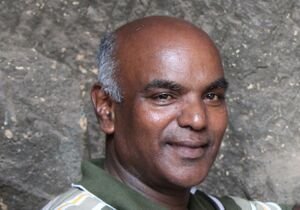
Paavannan is a Tamil author who has made significant contributions to fiction, literary criticism, and children’s literature. Furthermore, he actively participates in translations from Kannada to Tamil. He depicted the geographical area around Cuddalore and Pondicherry in a direct and realistic style. He has been recognized for his substantial contributions to the rise of the Tamil Dalit literary movement by translating Dalit literature from Kannada to Tamil.
About
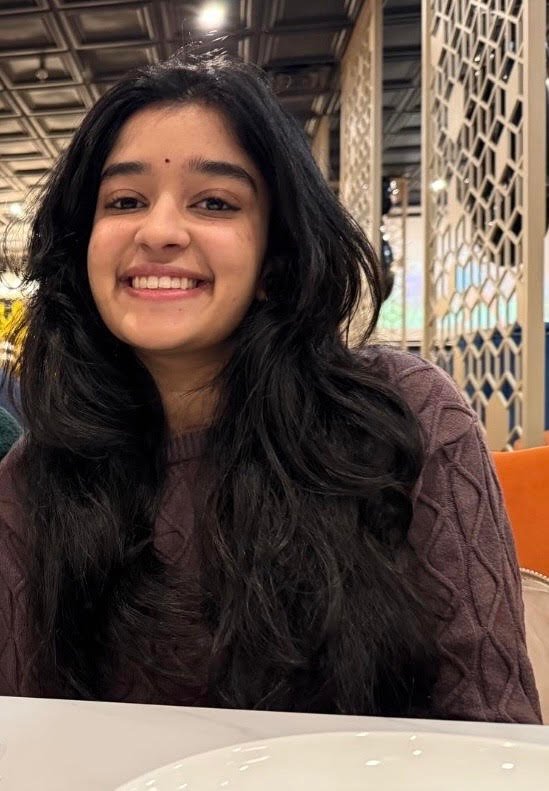
Megana Kumar is an undergraduate at the University of Virginia majoring in Biology with a minor in Sociology. She enjoys translating literary works from Tamil to English and analyzing them, and runs a book review channel on YouTube with her sister Sahana. She hopes her work can be a pathway for Tamil American youth to connect with their roots. When she’s not writing, you can find her hiking, reading comics, or drawing.