TURIYA LITERARY REVIEW
TLR Issue 3 - Fall 2026
The Stone Cave
Fiction by Jegadeesh Kumar
1
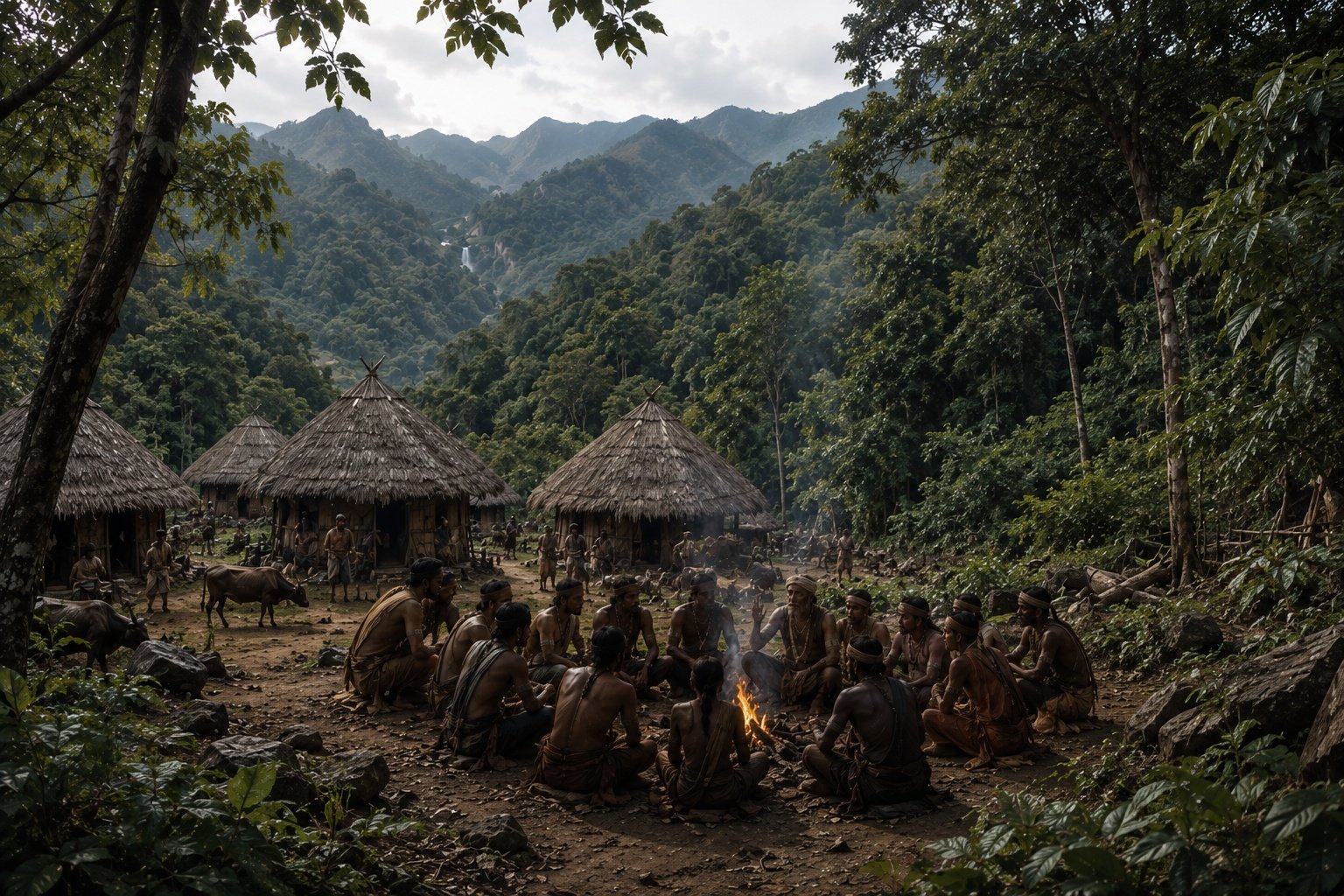
“Will my only child live on? Will I get to watch him grow?” Bommi asked her husband as she stroked the head of her newborn who was suckling at her breast in her lap. Her husband scratched his unkempt beard and wrapped his blanket tightly around his body to keep warm. He did not answer her, because he, too, had the same nagging question which, for the past six months, had been the only question, the only concern, that bothered every villager in the hilly forests of Gangamoola.
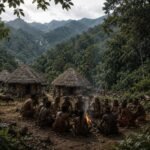
The five tribes’ leaders sat under the rosewood tree nearby, having offered their prayers at Hirayiri, their ancestors’ place of worship. The darkness descended quickly, like a swarm of dark vipers, and a campfire was lit in a pile of pinewood logs in front of the leaders to keep the cold at bay. Forty people were gathered in the presence of the elders, eight from each tribe. The fear and distress on their faces could be seen in the flames of the fire. As darkness descended, the valleys and the mountain ridges around them began to sink into silence. The air smelled of green leaves and cattle dung from nearby cages. An owl was hooting in a child’s voice from the valley to their right.
“We’ve lost three children in the last two weeks, sir. Please, do something. I’m scared to death if I won’t have a child to carry on the name of my tribe,” said Bommi’s husband. A few seconds turned his way for a brief second before sinking into their lowered position.
Gajaveeran, the leader of the Siddhi tribe, broke the silence that had returned to the assembly. “Has anyone seen the tiger that came into the village? How did it look?”
Bommi put her hand up in the air. “He towered above my head, standing on his hind legs. I saw him from about five feet away. He had a cave-like mouth, his fangs looked ferocious. Ayyo! Didn’t I see my child between the beast’s teeth!” Unable to say more, she burst out crying. The tiger had just taken one of her twin boys a few days before.
Gajaveeran shifted his gaze to the leaders. “It must really be a huge beast. Let’s ask King Ballala to send some of our men who guard him with spears and swords to assist us in killing the animal. We shall pierce the tiger with spears. When he writhes on the ground, fighting for his dear life, we shall cleave him with swords,” he said.
“Do you think the king would care? Do you think he even treats us as humans? We are just vermin in the eyes of the king. He is only interested in the mountain honey we squeeze and the venison we gather by hunting. Our lives don’t matter to him,” said the Kolidhor leader. He’d had a string of humiliating encounters with the king.
“So far, we’ve only lost cattle to the tiger. Now, the wretched animal is taking our children as well. Something must be done,” said the Nykda leader.
“Let’s kill the tiger with poisoned arrows,” a man in the crowd suggested.
“The tiger, according to Bommi’s account, is enormous and powerful. I don’t think our arrows will stand a chance. Who among us is the maker of the arrow that will pierce the beast’s flesh?” said Gajaveeran.
“I’ll kill the beast,” said Hakka to Bastava, who was standing nearby. The two had stood apart from the crowd, under a banyan tree, keenly watching the proceedings. “I’ll make an arrow that pierces his body. I’ll use it to kill him and gain the goodwill of all the five tribes of the hills.” His voice was firm and his face determined. Bastava looked at him surprised.
“We are the children of these hills, Hakka Rao. In the face of this tiger, even we are at a loss for what to do. But you are a complete stranger to this place. How can you possibly achieve this feat?”
“Don’t you know our Hoysala dynasty sprang from a warrior who killed a tiger at the behest of his teacher? Isn’t it his blood that flows through my veins?”
“Alright, alright, your valor is much appreciated, heir of the Hoysalas! Let you be the one to kill the dreadful tiger. Your mention of the teacher reminds me, it’s time to bring food for our gurusami. Shall we leave?” said Bastava.
***
2
The food for the guru had been cooking since noon in the residential area, inside the hut where Hakka lived. Slowly cooking rabbit meat, pulses, grains, tubers, and various vegetables seeped into each other, losing shape and form. Bastava used a ladle to stir the food and see if it had reached the desired consistency. The room was filled with the sweet aroma of tubers and meat melting and fusing. He scooped some porridge from the vessel and poured it into a bowl to let it cool for a while until it reached a comfortable temperature. Then he wrapped a bauhinia leaf around the bowl and took it in his hand. Both men emerged from the hut after Hakka had placed some fruits in a basket, and began walking toward the guru’s cave. The guru ate only a little from the enormous amount of food they brought him every day. He’d make them sit down and demand that they finish the leftovers. He would ask them to bring a smaller amount of food the next time around.
The two men walked in the moonlight on a narrow dirt path flanked on both sides by giant trees. Hakka gripped the fruit basket with one hand and his bow that slung over his shoulder with the other. It was getting dark, but the guru’s bedtime was still a few hours away. After eating, he would spend a long time writing on palm leaves. He never heeded to their offer to stand guard at the cave’s entrance at night.
“Hakka Rao, I have faith that you will kill the tiger. But are you willing to do this because you want to repay our tribes for saving your life?”
“That and I need the tribes to do something else for me as well. I want the five great mountain tribes, Kolidhor, Kondu, Marathi, Nykda, and Siddhi to be the guardians of the empire I will soon establish. When my kingdom is guarded by the valor and fearlessness of the tribes, the Delhi Sultan cannot harm my empire. In exchange, I will ensure safety and dignity for your people in my kingdom. I’m here to make your lives better.” Hakka’s voice shook with emotion.
“Hakka! Anna! Will you stop teaching me Sanskrit when you become the king?”
“Bastava, you are like my younger brother. You will be my commander, and you’ll always be by my side, as a bulwark to me and my kingdom. Why do you always bring up studying? What are you going to do, write on palm leaves with your knife pen? Take out your sword. Fight and live forever in History. Or do you want to study and become my minister?” Hakka said with a sarcastic smile.
Bastava Chuckled. “I have no such desire. There are no spiritual texts in our Konkani language. If I knew Sanskrit, I could read a lot more. I was looking through some of gurusami’s palm leaves the other day. I could read them, but the meaning of the text was difficult to grasp.”
“Aren’t we going to meet him in a few minutes? Why don’t you just ask him?”
“What? Me talking to gurusami? My body trembles just at the sight of him. Not out of fear though. Looking at him seems to me to be looking at the creator himself.”
“Even though your tribes worship different gods, you all pay the same homage to this one.”
“Anyhow, Anna, it warms my heart to know that you are working for our people’s well-being. I’ll join you shoulder to shoulder. I will give my life for you,” said Bastava.
About ten months ago, Hakka was found unconscious among the brambles with bruises and lacerations all over his body and was rescued by a Siddhi man, who took him to his leaders. The Delhi Sultan’s tyranny had been spreading throughout southern India. The great kingdoms of Kakatiyas, the Seuna Yadavas and the Hoysalas had already been conquered by him. Their kings were brutally assassinated. Those who fell on his feet for their dear life were converted. When Hakka Rao and his brother Bokka Rao, members of the Hoysala dynasty, were serving as guards in the kingdom of Kambili, Kambili was also plundered. The brothers managed to flee the Sultan’s forces. Hakka waited with a single hope, that the brother who parted from him that day would one day come back looking for him.
The mountain tribes accorded kingly honor for Hakka. The seventeen-year-old Bastava was immediately drawn to the newcomer. He regarded him as a hero and was frequently seen with him. He ate, worked, and slept in Hakka’s hut. In his spare time, Hakka taught him Sanskrit language. Hakka intended to keep the boy with him after seeing his agility and skill. He believed that appointing a tribal member to a position of power in his future government would earn their trust and support. Even as the tribals showered him with royal honors, Hakka could sense that he was still considered an outsider. Hakka saw the tiger’s entry as an opportunity to gain their trust and become one of them. He hoped that his wish would be granted if only he could kill that dreadful animal.
That night, Hakka made himself a promise: he would tell the guru what had been troubling him. His heart was pounding. The tribes would undoubtedly follow whatever the guru’s command was. The guru, who spent his time meditating and conducting spiritual enquiry, had also arrived here only recently, a few months before Hakka. All the five tribes accepted him as one of their own and revered him as a god. No one knew exactly who he was or where he came from. Some said he came from the north. Some said he was known as Vidyaranyaka or Maduracharya. The tribes, however, referred to him as gurusami, the great teacher. Hakka wondered if he, too, like him, had come here to escape Muhammed-bin-Tuglak’s oppression. The guru’s words, which he only spoke on rare occasions, were revered by all the hill tribes. He lived in a small cave outside of the tribal village. Each morning he went to a nearby waterfall to finish his morning ablutions before returning to his cave to meditate and study scriptures. There had not even been a gate to the cave. Only after the tiger broke into the village did Hakka build a crate to close the cave’s entrance at night. Bastava was the one who carried the guru’s food in the afternoons and evenings before Hakka’s arrival. Hakka joined him a few days after he arrived. The guru saw that Hakka was educated and he made him sit on their visits to teach him lessons from the Vedanta Philosophy while Bastava stood outside, listening and comprehending to the best of his abilities. The guru never asked Hakka a word about who he was or where he came from. Even though he had little interest in the subject, Hakka listened patiently to the guru’s teaching, waiting for a chance to share his own troubles and the plans he had made to overcome them. But the guru never showed the slightest interest in anyone’s personal affairs, let alone Hakka’s. That evening, Hakka resolved to create a conducive situation in order to share his thoughts with the guru.
***
3
Hakka entered the cave alone with the food bowl, leaving Bastava at the entrance. Immediately, he returned and beckoned for the boy to enter. Gurusamy himself had invited Bastava inside. The boy entered the cave with a thumping heart and a blushing face, unable to control his excitement. The cave appeared to be too small for three people, with a roof so low that a slight jump could knock one’s head off. Bastava was surprised to find the inside of the cave warmer, like the womb of a mother, he thought. The rough, amorphous, rocky walls glistened in dampness. In one corner a heavy, musty carpet had been rolled up around a flattened pillow. In another corner the guru sat on a wooden platform covered with deerskin. At close quarters, the guru looked shorter and his lion’s mane shone in the oil lamp. He gestured for him to sit across from him. His pupils were like pebbles stuck in a frozen pond. Bastava sat beside Hakka.
“What is your name?” the guru asked Bastava. His voice was thin and weak. The boy was looking at the bundles of palm leaves piled up behind the guru. Is he reading all this? Or did he write it all himself?… To alert him, Hakka nudged his thigh. Bastava straightened up and said his name. The guru began to speak, then stopped, and smiled at them.
Hakka began hesitantly. “Master, I have a request to make.” Guru turned his gaze to Hakka, his smile still lingering on his lips. He kept staring at him, as if waiting for him to speak. Hakka patiently explained how a single word of command from the guru could persuade all five tribes to support him. He also informed him of the tiger’s recent atrocities and advised the guru to exercise caution. He told him that he was going to prepare to kill the tiger.
The guru, who had been nodding gently in approval of Hakka’s words, said, as though prophetically, “Hakka, you will become an emperor!”
Then he said, “Shall we begin the lesson?”
The Guru explained a section called Jeevan Mukti Swaroopam from his book Jeevan Mukti Vivekam, which he was working on at the time. Bastava could clearly understand his explanation. After breaking down the long sentences he had written in Sanskrit and explaining them word for word, the guru patiently elaborated the entire meaning of the sentence. One sentence defined the meaning of the phrase Jeevan Mukti. Bondage, known as samsara in Sanskrit, is caused by thoughts such as, ‘I am the doer of an action, I am the enjoyer of it, I am happy, I am sad’ and so on. One is afflicted with such thoughts and falls into sorrow because one is unaware of one’s true nature. True liberation, Jeevan Mukti, is freedom from such false thoughts. The guru claimed that the body, mind, intellect, and ego are all mere material objects, and it is the Self – the pure, undivided consciousness, that gives them existence. Then he kept the discussion interesting by alternating between the Purva Mimamsakas, who objected to these ideas and the Siddantins, who upheld the Vedantic vision. Bastava swallowed each of the guru’s words, his eyes twinkling, while Hakka continued to nod violently, as if to kill the passing time.
Hakka reminded the guru once more as they parted ways. “One word, Guru, just one word is enough,” he said. The guru responded with a smile.
“Hakka, I was able to clearly understand the Sanskrit words that the guru explained this evening. I thoroughly enjoyed his teaching,” Bastava said as they were returning to their hut.
“I thought so too that his explanation today was extremely clear and lucid. I had a feeling that he made things easier for you.”
“Given the chance, I’d spend the rest of my life studying these scriptures with the guru.”
“Can a sword-wielding hand drop it for the sake of a text? This philosophical exploration is only appropriate for the elderly, not for those determined to protect their own people. You are the commander who will stand alongside me. I doubt you’ll have time for all of this.” Hakka abruptly ceased speaking and stopped walking.
“What?”
“Look!” He pointed to the moonlit foothills made of barren lands and forest trees below. “There I will form my kingdom. My people will prosper along the banks of the rivers of Tunga, Batra and Netravati. It will be the most powerful empire this Bharatvarsha has ever seen. The tyrant Sultans cannot even lay their heads on the side of my empire,” he declared.
Bastava saw Hakka’s dreamy eyes in the moonlight.
***
4
There had been no trouble from the tiger for the past ten days. The mountain tribes lived in constant fear that the tiger would break into their homes at any time. Hakka worked methodically, sliding iron styluses into the Siddhis’ wooden arrowheads to give them strength. He vowed to be fully prepared the next time the tiger descended. He told Bastava to stay with him and that he was also making arrows for him. Bastava was building a wooden shelf out of rosewood scraps. “There are many palm-leaf manuscripts piled up inside the guru’s cave. I want to keep them all organized on this shelf so that he can quickly select the required text,” he explained.
They took the finished shelf to the guru’s cave. They were only able to get the shelf, which was taller than the cave’s entrance, inside by holding it sideways. Even then it rose to three quarters of the height of the entrance. Hakka looked at Bastava as if to say if such a large shelf was necessary at the time. The guru stood, as usual, oblivious to what was going on around him. Bastava arranged the palm leaves that had piled up in the corner neatly on the shelf, which had been placed against the wall closer to the entrance.
Two days later the news came that the tiger had descended into the village. Everyone took their bows and wandered into the jungle in search of the beast. Gajaveeran called Hakka and asked that he stand watch near gurusami’s cave through day and night, claiming that a village woman had reported seeing lacquer-colored movements in the valley behind the cave. Although he was eager to find and kill the tiger, Hakka had no choice but to accept the leader’s request and go there. He and Bastava went to the guru’s cave early in the morning. While the Guru went about his business inside, the two kept guard outside the cave under the pongame tree.
They stood there for about four hours. The sun was high in the sky, scorching their backs. Wiping the sweat off his brow, Hakka suggested that they sit for a while. When they were about to settle down on the ground, a villager came running from the other side and, panting profusely, reported that someone had spotted the tiger, hopping and jumping among trees in the residential area. Hakka asked Bastava to stay put and then left with the villager.
Bastava did not feel inclined to sit under the tree once Hakka had left. He could feel his chest pounding. Is this tiger a magician? It appears in one place right now and another the next! What would I do if the tiger appeared right now out of nowhere? His body began to tremble as sweat trickled down his neck and moistened his chest. The air around him had come to a halt. He inhaled deeply, filling his lungs with vital air. Can I confront the beast? Is the guru’s cave’s entrance closed? Can a frail, timber crate withstand the tiger’s mighty power? Ayyo! What if the tiger enters the cave?… He dashed to the cave’s entrance to ensure that it was closed with the crate, then returned to stand at his position beneath the tree.
He found himself suddenly alone, with no one to lean on. It was as if the mountain forests he had grown up in had abandoned him. The cloudless sky stretched above him like a spotless shamiyana. The ground seemed to slip beneath his feet. Will this body, which roamed these mountain forests for seventeen years, fall prey to the tiger? As Guruswami said, is the body just a perishable mass?
He heard something move from the trench to his left. He turned, trembling, expecting to encounter the tiger at any moment. Nothing seemed to have come out of the trench, despite the fact that he could plainly hear hard breathing. A few branches above swayed. Before he could raise his head the tiger, as if leaping directly from the heavens, landed heavily on the ground in front of him and stood up, looking him in the eyes.
The beast staring at him with his beady eyes almost exactly matched Bommi’s description. When standing, the tiger towered over him to his breast. He kept his gaze fixed on the boy, but did not pounce on him. Yet. Bastava stood frozen in terror. He feared that if he made a slight move, the beast might leap on him. The tiger yawned, exposing his monstrous fangs as he drew his body back, dragging his forelegs on the ground. It seemed as though he might pounce at any moment. Bastava mustered the courage, drew an arrow and fixed it on the bow.
Seeing him move, the tiger turned sideways, as if scared. His arrow grazed its tail. The tiger bolted away from him and entered the guru’s cave. The boy panicked and ran behind the beast. He noticed the guru standing there, blocking the entryway. “Gurusami!” he yelled as he noticed the tiger standing behind the guru, inside the cave and moved toward him. The guru stomped on the boy’s chest, causing him to collapse backwards. The guru slid the cupboard to the ground and shut the cave’s entrance. Bastava heard the tiger’s horrendous growl inside. The guru let out a terrible groan. Bastava got up and ran to the side window. The glimpse of what he saw inside shook his entire body. As the guru collapsed, the tiger pushed its forepaws against his chest and stomach, goring him in the throat. The guru’s legs flailed and throbbed on the ground. Bastava fixed an arrow to his bow and fired it through the window. He continued to shoot arrows. An arrow pierced the tiger’s belly. Another pierced its throat on the side. The tiger staggered away from the guru. Basatava could not stand witnessing the guru’s gored state. His blood was gushing out all around him, soaking his ochre robe.
When Hakka returned sometime later, the guru had died. The tiger was dead too. Bastava sat on a rock outside the cave, crying bitterly, unable to bear the sight. When he saw Hakka had returned, he jumped up and ran to him and hugged him and cried. “Aiyo! Anna! I could not save the guru!”
Hakka hugged him tightly and comforted him.
***
5
A statue of the guru was placed in Hirayiri, the site of worship for the ancestors. For his sacrifice for the welfare of the people, the guru was venerated as a god among the five tribes. They applauded the warriors who had killed the tiger, and a deep, collective relief settled over the five tribes, their faces lifting again into smiles and easy cheer. Hakka now became worthy of the tribal leaders’ trust. One hundred and fifty youngsters were assigned to accompany him to the plain, clear the forest, build huts, and prepare the groundwork for the new kingdom’s establishment. It was the day when they were scheduled to descend the mountain. The tribals bade them farewell as if it were one of their festivals, drumming thambattai and Muzhavu, the tribes’ percussion instruments, playing beeki and singi, their wind instruments, and dancing with their anklets worn. Food and supplies for the journey were wrapped in cow skin and loaded on donkeys. The chiefs had given Hakka and Bastava a horse each. Hakka was watching his escort while adjusting the saddle on his horse. His eyes were searching for Bastava, his commander.
Bastava dashed down the opposite slope, panting. He looked haggard and desolate.
“Pardon me Hak… my lord! I’d just gone to gurusami’s cave. I’ve stored his palm leaves safely stacked in wooden boxes to keep them from eroding.”
“Have you double-checked that you have everything you need for the trip?”
“Here, I will see to it, king!” He was attempting to get away from there as quickly as possible. His eyes averted Hakka. Hakka put his hand on his shoulder and stopped him.
“Have you packed your supplies and weapons?”
“Ah…I’ve asked my mother to help me with that. She would’ve done it.”
“Walk with me,” he said, placing a hand on his shoulder and leading him away. They both walked away from the residential area, towards the edge of the hill, which was overgrown with smilaxes, velvet beans, and hidden-lilies. The sun had risen above the edge, casting a yellow glow on the mountain. Bastava walked on, anticipating Hakka to say something. But he seemed to be deep in thought. Silence had enveloped them both like a blanket. No sound except the crunching of fallen leaves on the mudpath.
Hakka took out two bundles of palm leaves from the string pouch slung over his shoulder. “These are the guru’s Naishkarmya Siddhi Sutras. I saved these, eager to have them installed in my palace. Here, take these as well. Let his treasure of knowledge not be confined to wooden boxes. You stay here and start learning them slowly. The Sanskrit I’ve taught you is sufficient for that.”
“Anna, am I not coming with you?”
“Your place, Bastava, is here. You must remain here to study the guru’s lessons. I will send people to learn from you. You have a strong desire to learn.”
“Anna, Gurusami pushed me away the other day and fell prey to the tiger. It was a great sacrifice. His action proved that there is something eternal beyond the perishable body. Shouldn’t I know what it is? My heart aches to know what it is, Anna!” said Bastava pleadingly.
Hakka turned his head and gazed down on his soon-to-be-established dominion, the yellow light of the evening sun bathing and embracing its forests and barren lands.
About
Jegadeesh Kumar writes, both in English and Tamil, short stories, poems, and Eastern Philosophy. His work has appeared in The Prometheus Dreaming, Indian Periodical, Spillwords Press, The Defunct Magazine, Piker Press, Impspired magazine, Consequence and elsewhere. A Fine Thread and Other Stories – a short story collection in his translation has been published by Ratna Books India in January 2024. Jegadeesh Kumar received the prestigious Translation Prize from the Canada Tamil Literary Garden in 2024 for his work A Journey Through Words – a book of literary non-fiction. He has also published a collection of his short stories in Tamil Porkugai Ragasiyam (The Golden Cave Secret). Jegadeesh has compiled and curated two anthologies to be released in the Living Tamil LitFest, New York City, in April 2026. A member of NSLS (National Society for Leadership and Success), he has won the Robert Noyce Educator scholarship to complete his Master’s degree in STEM Education at the Citadel Military College of Charleston, SC.